Near the end of 2025, Eric “ConcernedApe” Barone, the solo developer behind the wildly popular indie game Stardew Valley, announced a $125,000 donation to the MonoGame Foundation. The MonoGame team called it “an extraordinary show of support.” But Barone’s approach to game publishing, along with his donation, also underscores why giving back makes business sense.
The Game
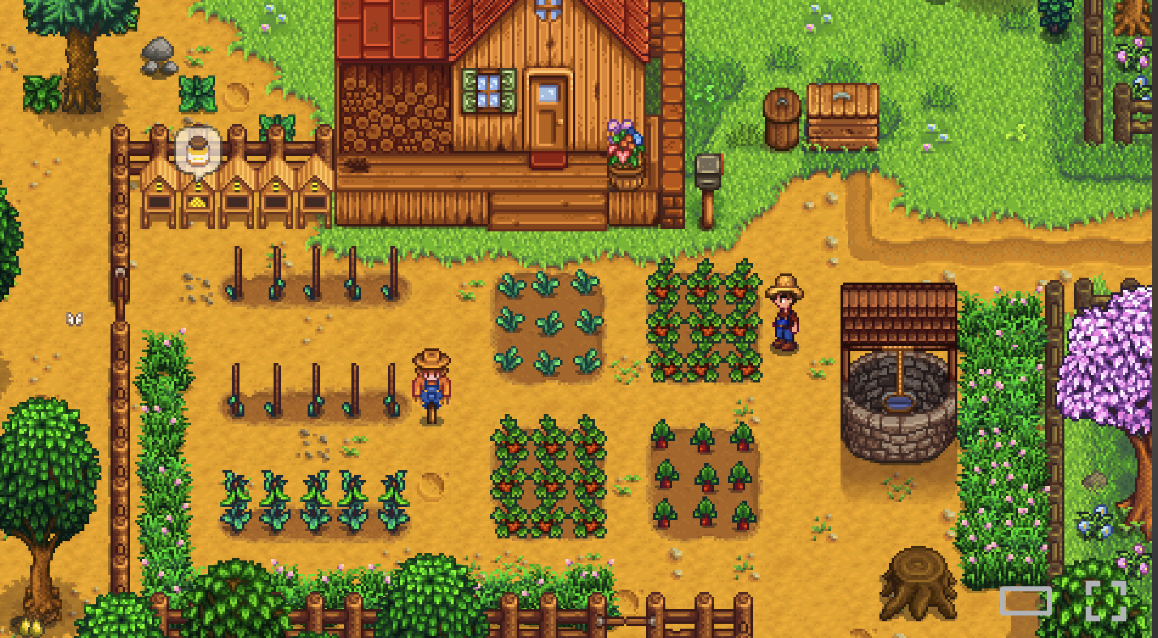
Stardew Valley was released in February 2016 after nearly four years of solo development. Barone famously created the game single-handedly: graphics, music, gameplay, and script. On the surface, Stardew Valley is a simple farming simulation game, with retro graphics. But it was much more than that.
Stardew Valley became a cultural touchstone because it struck a nerve with players due to its cozy gameplay and gentle vibe. The game essentially has no clear objective and no clear end. While other games require fast reflexes, or amassing loot to achieve an objective, or dangle in-game purchases before players to enrich the publishers, Stardew Valley simply invites you to tend a garden, be kind to your neighbors, and tune in to the quiet rhythms of rural life. Particularly during the anxiety-filled years of the COVID-19 epidemic, many players found comfort in its low-key gameplay.
I have to admit I’ve done a few farms myself, and a few aspects of the game impressed me deeply. First, it’s a stellar lesson in resource management. There is really no way to “game” progress; you have to just plan, do the best you can, and keep going. It’s almost like an educational game: plan, tend your garden, and seek out opportunities. Farming is tough, and success at it requires persistence and planning.
But also, if you fail at something in Stardew Valley, you can just try it again later. Most games are more college entrance applications–if you fail, you feel like you are at a disadvantage forever. But Stardew Valley is more like real life. If you fail, you can try again–or don’t. There’s no need to succeed at everything, and playing the game is enjoyable for its own sake. And like real life, if you are successful, you eventually stop worrying about what you can achieve. You just create things for the fun of it. There are some deep life lessons there.
The Community
The game has sold over 30 million copies as of 2024, which is a staggering achievement for any game, let alone an indie game. The game’s success is thanks, in large part, to Barone’s attitude about the game’s community. Unlike many modern games that launch incomplete and patch themselves into coherence, Stardew Valley arrived as a complete, polished experience. But Barone didn’t stop there. For years after release, he continued adding substantial free content updates, expanding the game in ways that respected players’ existing farms and relationships with the world he created. In this respect he followed the promise of open source software: free updates forever.
But also, he specifically designed the game to allow modding–making changes to the game on your own. The modding scene for Stardew Valley is extraordinary both in scope and sophistication. The Internet is full of people showing off their mods, and following crazy strategies to create things that have nothing to do with “beating” the game. Some mods add new crops, animals, and items. Others introduce entirely new locations and questlines. The game has a dating and marriage feature, and early mods added new options to fit alternative lifestyles. It’s probably fair to say that through modding, the game has evolved in directions Barone never imagined.
Baron’s generosity established a relationship of trust. As a result, players have a deep and enduring love for both the game and its creator. Where other publishers might have seen lost revenue or diluted brand control, Barone saw how allowing modding would widen his audience. It worked. Mods have kept Stardew Valley perpetually fresh and relevant, creating thousands of entry points for different player preferences and maintaining an active community long after most single-player games would have fallen off the gaming radar.
The Tech
The tool that makes much of this openness possible is SMAPI (Stardew Modding API, see https://smapi.io), a community-created mod loader that allows mods to work together without conflicts and updates automatically when the base game changes. SMAPI tracks the collaborative ethos of open development. It is maintained by volunteers who receive no direct compensation from game sales.
The technical foundation that made Stardew Valley possible was MonoGame. (https://monogame.net/) MonoGame is an open-source game framework that allows developers to write games in C# and deploy them across multiple platforms—like Windows, Mac, Linux, iOS, Android, PlayStation, Xbox, and Nintendo Switch. If a game–particularly an indie game–is to reach a wide audience, it has to be on all the major platforms.
MonoGame is a successor to Microsoft’s XNA Framework, a popular game development framework that Microsoft discontinued in 2013. (Perhaps that is why it uses the Microsoft Public License. This is Micrsoft’s mostly permissive open source license, which, while a well-written license, is not all that commonly used.) When Microsoft abandoned XNA, a community of developers who had built their workflows and expertise around it, and took it forward as a community-driven effort, adding new features and platform support. The framework allows developers to use standardized APIs for audio, keyboard, controllers, and touch screens.
This abstraction is especially crucial for cross-platform development. Without it, indie developers don’t have the resources to maintain custom versions of games on so many platforms. Open source gaming platforms help democratize game development, lowering barriers to entry and enabling stories that might otherwise never be told.
But MonoGame, like much open-source software, struggles with resources. The MonoGame Foundation is a nonprofit organization that coordinates development, but the actual work of maintaining and improving the framework is done largely by volunteers—developers who contribute their time and expertise out of passion for the project and commitment to the community.
A volunteer model ensures that development is driven by community consensus rather than commercial pressures. But it also is hard to sustain, placing a burden on volunteers who can get burned out or simply move on. This dilemma is not news to anyone in the open source world.
The Donation
Eric Barone’s $125,000 contribution, combined with an ongoing monthly commitment, is an important injection of sustenance for the MonoGame project. Beyond its immediate practical impact, the donation sends a message validating the framework’s importance and showing how commercial success built on open-source foundations can flow back to support and strengthen the community.
The COSS Mindset
COSS represents both a business model and a philosophy—a way of building sustainable businesses on open-source foundations while preserving the openness and community ownership that makes open source valuable.
Traditional open-source philosophy is about freedom and collective work. Software should be freely available, modifiable, and redistributable. The community controls the evolution of projects. This philosophy has produced extraordinary value—the majority of the internet runs on open-source software, from Linux servers to Apache web servers to Android, and countless other libraries and frameworks.
But open source often struggles with sustainability. How do you fund development of software that anyone can use for free? The classic answers—donations, volunteer labor, foundations—work for some projects, but leave many projects chronically underfunded and undermaintained.
COSS offers an alternative approach: build commercial products using open-source components, or build open-source products with commercial support options. COSS deliberately creates sustainable business models while maintaining openness. This might mean offering a free open-source core with paid enterprise features, providing commercial support and hosting for open-source software, or building commercial products on open-source foundations and contributing back to those foundations.
Barone’s relationship with MonoGame represents a particularly interesting example of COSS, as broadly defined. He built a commercial product (Stardew Valley) using an open-source framework (MonoGame). His game succeeded commercially, selling millions of copies and generating substantial revenue. Rather than treating MonoGame as simply a free tool he happened to use, he’s now investing significant resources back into the framework, strengthening it for future developers.
This creates a virtuous cycle. MonoGame’s quality and openness enabled Barone to create Stardew Valley. Stardew Valley’s success generates resources that flow back to MonoGame. If successful MonoGame projects contribute back to the framework—whether through direct financial support, code contributions, documentation, or community support—the ecosystem can remain strong.
The COSS philosophy recognizes that “open source” and “commercially successful” are not contradictory but potentially synergistic. Open source creates value by lowering barriers, enabling innovation, and building on collective knowledge. Commercial success creates resources that can be reinvested in the open-source foundations that enabled that success. The challenge is creating structures and norms that encourage this reinvestment rather than pure extraction.
The Cultural Resonance
There’s something particularly fitting about this donation coming from the creator of Stardew Valley, which has spread such a feeling of community among its players. The game itself is about paying it forward, engaging with community, and the value of investing in shared spaces. Players restore a community center, revitalize a struggling town, build relationships with neighbors, and create value through patient cultivation of crops.
The same philosophy that shaped Stardew Valley‘s design—respect for players, generosity with content, openness to modding—extends naturally to how Barone has engaged with the broader development ecosystem. His donation reflects a worldview where success creates responsibility to support the commons that enabled that success.

Leave a Reply